Kenya pushes for better data to tackle corruption at global crime congress
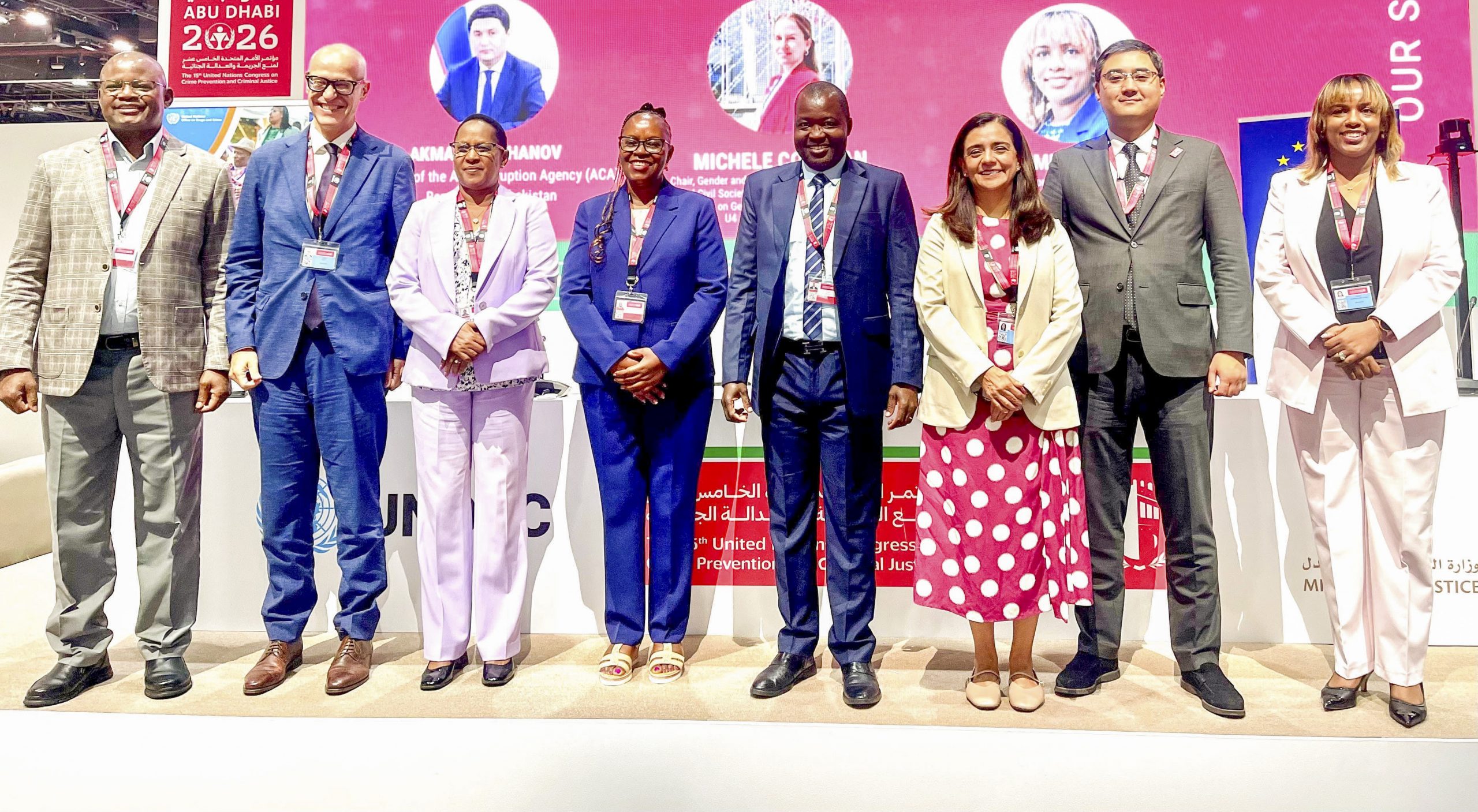
Third from left: Principal Secretary, State Department for Justice and head of the Kenyan delegation to the 15th United Nations Congress on Crime Prevention and Criminal Justice in Abu Dhabi, Hon. Judith Pareno; fourth from left, EACC Vice Chairperson Dr. Monica Wanjiru Muiru; and fifth from left, EACC Assistant Director for Research and Policy Collins Aluda, in a group photo with other delegates.
28:09:2026: Kenya has called for stronger use of detailed and disaggregated corruption data to identify institutional risks, guide targeted reforms and improve public service delivery, as experts from several countries examined how evidence can strengthen corruption prevention at a global crime conference in Abu Dhabi.
The call was made during an ancillary event organised by the Ethics and Anti-Corruption Commission (EACC) at the 15th United Nations Congress on Crime Prevention and Criminal Justice, where experts from Kenya, the United Nations, Uzbekistan, Kyrgyzstan and civil society examined how better data can strengthen corruption prevention.
The session, titled “Harnessing Data for Inclusive and Effective Prevention of Corruption,” brought together anti-corruption officials, statisticians, researchers and policy experts to discuss how countries can move beyond perception-based measures and use survey, administrative and institutional data to tackle corruption.
Principal Secretary for the State Department for Justice and head of the Kenyan delegation, Hon. Judith Pareno, opened the session by highlighting the importance of comprehensive and granular data in designing inclusive anti-corruption interventions.
Pareno also outlined the partnership behind the Kenya National Gender and Corruption Survey 2025 and linked corruption measurement to institutional reform and improved public service delivery.
EACC Vice Chairperson Dr Monica Wanjiru Muiru presented Kenya’s experience in using corruption surveys, corruption-risk assessments and systems examinations to identify weaknesses and support preventive interventions.
She also discussed the principal findings of the Kenya National Gender and Corruption Survey 2025 and how its recommendations could be translated into institutional and sector-specific measures. The implementation framework, she said, would need to account for differences related to gender, age, disability, income and geographical location.
The survey was undertaken by the EACC in partnership with the Kenya National Bureau of Statistics, the National Gender and Equality Commission and the United Nations Office on Drugs and Crime (UNODC) to generate gender-disaggregated data on experiences and perceptions of corruption.
From the UNODC Research and Data Analysis Branch, Salome Flores examined how the UNODC Statistical Framework to Measure Corruption could help countries integrate survey data, administrative records and institutional indicators while maintaining international comparability.
She also addressed the institutional and statistical arrangements needed to establish sustainable national corruption information systems and use data to assess whether anti-corruption laws, policies and programmes are achieving their intended results.
Akmal Burkhanov, Director of the Anti-Corruption Agency of the Republic of Uzbekistan, shared his country’s experience in using sectoral and institutional assessments to identify priority corruption risks and translate findings into preventive measures and institutional reforms.
Tilek Kudaiarov, Deputy Head of the Department of International Legal Cooperation at the Prosecutor General’s Office of the Kyrgyz Republic, discussed the use of prosecutorial, criminal-justice and administrative information to identify recurring corruption risks and strengthen institutional controls.
Joining virtually, Michele Coleman, Chair of the Gender and Corruption Data Taskforce of the Global Civil Society Coalition for the UNCAC Working Group on Gender, Inclusion and Corruption, examined the importance of gender in understanding corruption in the health sector and the need for gender-disaggregated data.
Asmert Tesfai of the UNODC Regional Office for Eastern Africa, who also served as the event organizer, moderated questions and comments from participants, with discussions focusing on the integration of survey and administrative data, translating evidence into preventive interventions, and opportunities for technical cooperation and knowledge exchange.
The session concluded with a call for stronger collaboration among national and international institutions and greater use of disaggregated corruption data to translate evidence into inclusive preventive interventions.
The discussion was moderated during the closing session by Collins Aluda, EACC Assistant Director for Research and Policy.
The EACC team is led by Dr. Muiru and included Deputy Director for Research and Policy Nancy Namenge and Assistant Director Collins Aluda.
The congress is being held in Abu Dhabi from September 26 to October 1 under the theme “Accelerating crime prevention, criminal justice and the rule of law: protecting people and planet and achieving the 2030 Agenda for Sustainable Development in the digital age.”